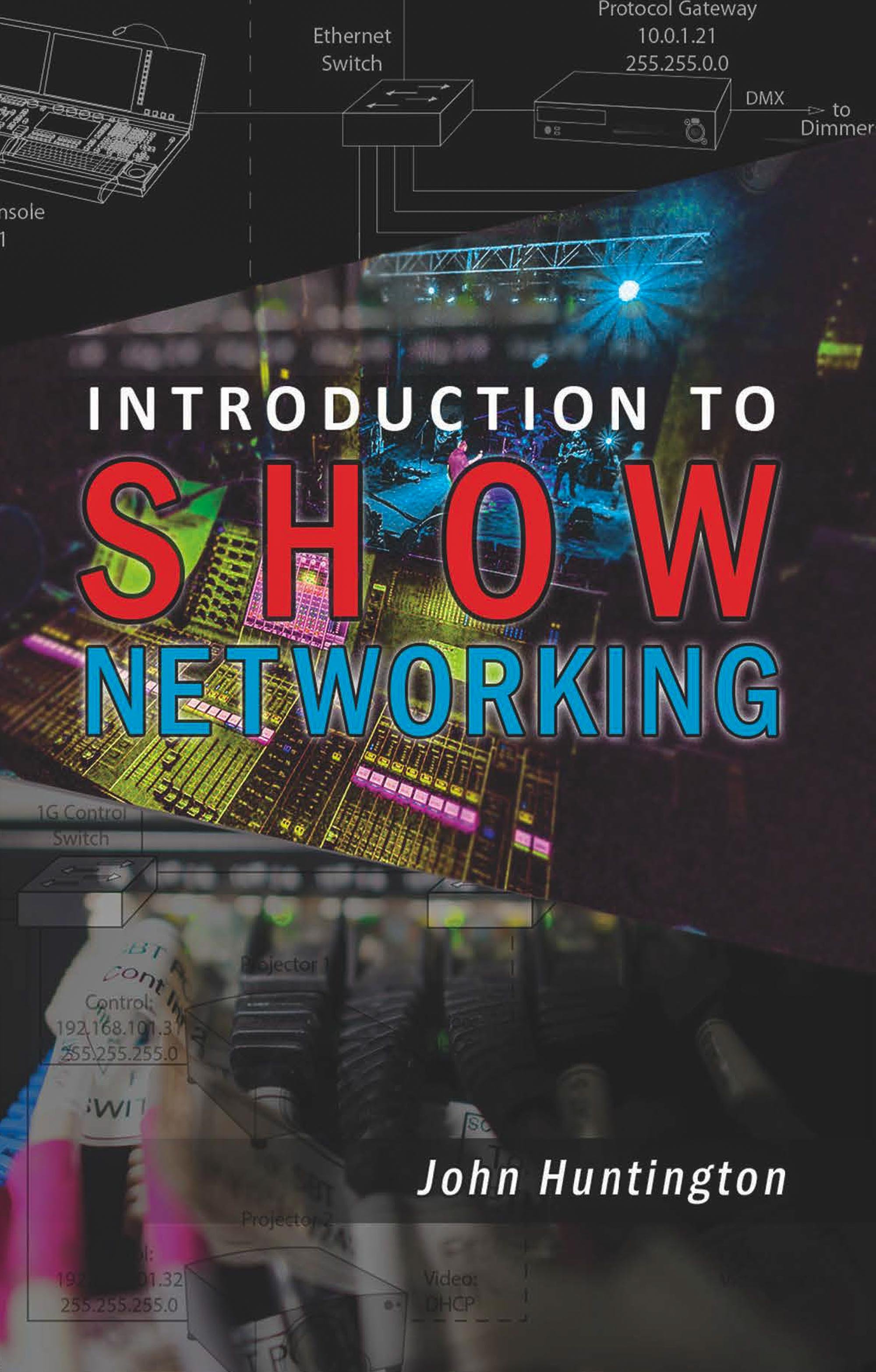
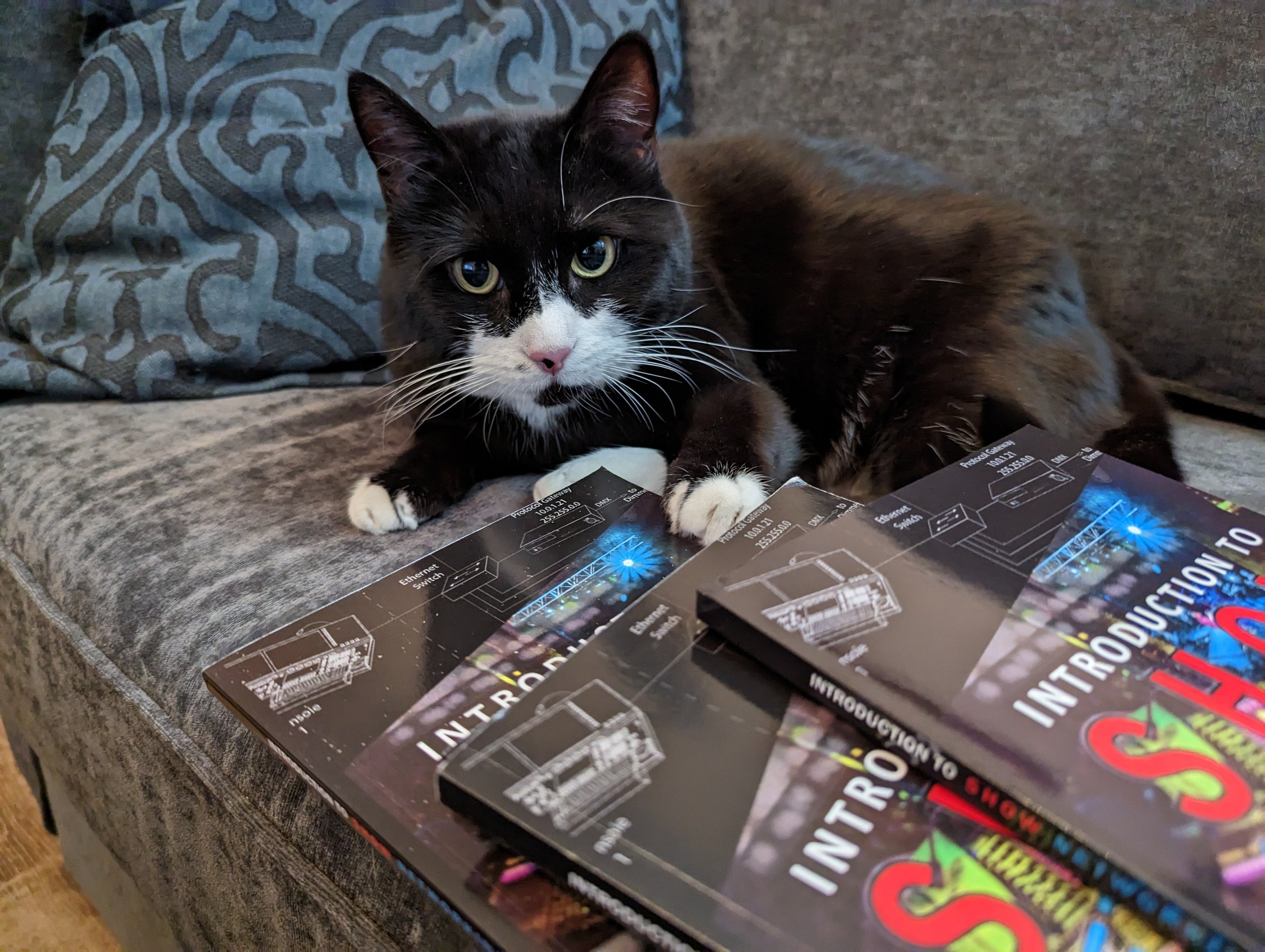
#USITT will be selling, and I will be signing copies of my book, Show Networks and Control Systems, Friday at 12:30 PM Central Time at the USITT booth. Please stop by and say hello!
For 48 hours starting Friday, I ran a "pay what you will" promotion on my book, Show Networks and Control Systems.
There were 420 total downloads (391 in the US and Canada, and 29 in the UK and Europe), and 59 donations. So that means that 14% of people who downloaded the book donated. I'm not sure, however, what that really means, since I had to run the Kindle free download on Amazon, and the donation part here on my website. Amazon doesn't give me any referral/download/purchasing information (although you know they have it), so it's quite possible that a lot of those downloads were people who found the book free on Amazon somehow, and didn't even know about the donation possibility. This whole thing started, too, as a way to give the Kindle edition to those who already had the print edition, so that might account for some of those numbers.
For those that donated, thank you!!! 39% donated $10, 20% donated $20, 14% donated $5, and 7% donated $30 (the regular download price). Two people gave me $1, and I'm not really sure what to make of that (especially since after Paypal, I got 67 cents). Paypal's take varied from 4% to 33%, averaging 7% in total (I really hate that aspect of Paypal--it's always difficult to figure out what they will charge in advance). If you wanted to donate but forgot, the donate button on the link is still active!
The best part of the whole thing was the comments I got on some of the donations. One said he was unemployed and could not afford the full price, and another said he was a college student and really appreciated the break. One person gave me $25 just because he liked the pay what you will idea. I recognized 13 of the names on the donations, which is 22%.
I think this was a fun experiment In the end, and it was worth it since over 400 people now have the book that didn't before. But as a business model I'm not sure it's a solution. Fortunately, through print-on-demand Createspace, I've now made more in royalties than I did on the previous two editions with a publisher, and I've had a hell of a lot more fun! (It's still a lower hourly rate than working as a Local 1 stagehand, though.)
This Friday and Saturday I'm running a special "pay what you will" promotion on the Kindle edition of my book, Show Networks and Control Systems. To participate, just go to the kindle link for my book between midnight Pacific Standard Time February 22, 2013 and 11:59 PM Pacific Standard Time on February 23, 2013. You should be able to get the kindle book there for free, and then use the Paypal button below to pay whatever you like. The regular kindle price is $30.
Thanks!
p.s. I've never run a Kindle promotion before, so if you have any problems, please check back on this site for any updates.
I was reading USITT's TD&T journal on the train this morning, when I stumbled across the book review section, and found a very nice review of my book! I had sent in a book copy for review back in the summer, but forgot all about it, and it turns out that they selected Michael Hooker, who I know from various conventions over the years. I consider Michael a friend, but I didn't know he was reviewing it, and I read through it nervously. But am happy to report that Michael wrote a very nice review! Here's some of my favorite points:
One could argue that [the book] contains an overwhelming volume of information if it were not so impeccably well organized. Its thirty-three chapters place the book clearly in the category of technical reference, but it retains the style and flow of a unified narrative. ... It is a masterfully organized effort. ... Professionals who have never seen Huntington’s book probably already use these [system design] tenets, which are eloquently stated and spot-on good design practice. ... Of special note is his section on Ethernet, which, in my opinion, brings great clarity to this often misunderstood, yet essential method for interconnection. He then expands this into two more chapters that deal with TCP/IP, LANs, and the myriad of advanced networking topics that can trip up even seasoned professionals. Huntington’s presentation of these topics is particularly outstanding.
Here's his summation
Show Networks and Control Systems is more than just a timely update to the venerable Control Systems for Live Entertainment; it is a modern reassessment that truly reflects current trends and practices in the themed entertainment industries. I highly recommend this book for anyone interested in, or of course directly involved with, themed entertainment design. This outstanding work has become the primary textbook for my graduate courses in show control for themed entertainment. It fluidly straddles the line between textbook and reference manual and fills a very important niche in our industry.
You can read the whole review on the link above.
Michael has some worthwhile criticism in his "Three Minor Misses" section, and I'd like to address them here:
I think this book falls a bit short in explaining general electrical theory, especially as it relates to interfacing. This is apparent when he describes transistor interfaces. Admittedly, this could easily fill an entire book or semester course in electrical engineering, but an expansion here would function at the same level
as the rest of the book.
Michael has a good point here, and this is something I've wrestled with since the first edition back, way back in 1994. To understand anything about entertainment control, you need a solid foundation in electricity. But to explain those fundamentals I think you need another book altogether, and there are already many fine ones out there. On the other hand, I didn't want to just include a cursory overview of such a complex subject either, but there are some things that are important to the topic, so I didn't want to leave them out. I'll think on this some more for the next edition...
I see a potential big future for OSC. It barely gets five pages, and although it is currently not a widely adopted professional standard, the same could have been said about MIDI in the not-too distant past. I believe OSC is a very accessible format that young paradigm by translating it in and out to existing control standards.
I agree too that Open Sound Control (OSC) has a lot of potential, which is why I included it even in the last edition in 2007. But MIDI was already 10 years old and very well established back in 1994 in the first edition, and so I've included a lot of information on that from the beginning. I hope I included enough information on OSC to get people started, and as it gains acceptance (there's a major product in our industry that will soon announce support for it--had that happened before July I would have likely expanded the section) I will most certainly post info here on the blog, and will expand that section in the next edition.
And finally, I would have liked to have seen full examples from real, actualized shows! I understand that could have entailed certain legal and trade-secret limitations, but I missed the direct grounding to reality that this would have provided.
Many of the case study examples at the end of the book are drawn from real-life shows, but there's no way I could get approval to use them in the book. I did, however, give many of the origins of these examples in my recent free lecture video for those chapters, which you view here. The other reason I didn't include actual shows in the book is that they would almost immediately become dated. And so, I put that kind of stuff here on the blog, and you can subscribe to my RSS feed to see more.
Thanks again Michael, I owe you a beer at the next conference!
I've got my book up on Google Book search now, and with this custom box you can search inside it and preview pages:
I've completed the last of the supplemental videos I intend to do for my book, Show Networks and Control Systems. These are the videos I needed for my Show Control class at City Tech. You can find all the videos here, and I've embedded the four show control videos below:
Hans van Bemmelen let me know about a nice review of my book, Show Networks and Control Systems, in the Dutch journal Zichtlijnen, published by VPT, the Dutch association for stage technology. Mr. van Bemmelen was also very generous in making this translation for me:
Standard reference work on show control
By: Jos van de Haterd
John Huntington initially wrote his standard reference work about automation and show control in 1994 and three editions have been published since. This fourth edition has been changed and updated to such an extent that the book now has a new title. What used to be Control systems for live entertainment has now been published as Show networks and control systems. And it is indeed a different book now as Huntington not only updated the information, he also reorganised everything thoroughly. In part one he discusses what forms of automation and show control are used in different disciplines, from lighting and lasers to pyrotechnics, audio, animatronics and stage machinery. Highly informative and comprehensive. In part two he discusses what is covered by show control and what concepts there are (linear vs. nonlinear, event-based vs. time-based cues, absolute vs. relative data, feedback loops), basic electrical technology, counting systems (decimal, hexadecimal, binary) and his list of seven design principles for a show control system. Part three is about data communications and networks, the core of the book. He explains how data is coded and transmitted electrically (or in the form of light), he discusses network basics (from point-to-point to TCP/IP and virtual LAN), and issues such as USB, FireWire and Bluetooth. In part four he covers specialist protocols used in our industry, including MIDI and DMX512A and also MIDI Show Control, RDM, ACN, OSC (Open Sound Control), MVC (MIDI Visual Control) and NTP (Network Time Protocol). Finally, part five addresses the design of a robust show control system and discusses five case studies. The book is now more up-to-date and comprehensive and is still highly recommended to anyone who seriously wants to study the subject.
As I wrote in detail here, I've been researching my way through the byzantine world of ebook self publishing. What I really want is a DRM free, individually watermarked edition (probably in PDF). While publishers offer exactly that, I have not been able to find a company that will handle individually watermarked files for self-publishers (if you know of one please let me know!). And so, I ported the print edition over to DRM-enabled Kindle; the purchase link is here.
At this point, more people are interested in a print version than an E-Version (see my survey here),
so I did the initial layout for print, and this Kindle edition is a port of the print edition files (from Framemaker 10 to epub2 format to mobi format). The Kindle version does offer portability, search, cross references, index links back to the referenced page, etc. I didn't want to maintain two versions, and I didn't have time to reformat all 500 pages and hundreds
of graphics, so the e-edition layout is not optimal. I tested the file on an android phone, android tablet, and Kindle fire, and there are some issues:
Unfortunately, with Kindle, I have a lot less flexibility in promoting the book (and I actually make a substantially lower royalty than with the print edition), but I think I will be able to use a Kindle Direct Publishing "Select" promotion to offer--for a limited time--a discounted copy to those who already own the book. If you own a print a edition and would like a discounted kindle version, please enter your contact information here before February 1st, 2013.
Back in November, I started a special promotion offering $10 off my book, Show Networks and Control Systems. And, for each copy sold under the promotion, I promised to donate $10 of my royalties to Behind the Scenes, the great charity for backstage workers.The promotion ends today, and 43 people bought 48 copies of the book, so that's $480! Since this industry has been very good to me, it's been a good year, and the book has been doing well, I doubled that and donated $1000. Thanks to everyone who purchased a copy, and I hope you enjoy it!
p.s. I'll leave the discount code active for another day or so, act soon if you want $10 off!